Dubai Police Warns Against Fake Investment and Trading Offers

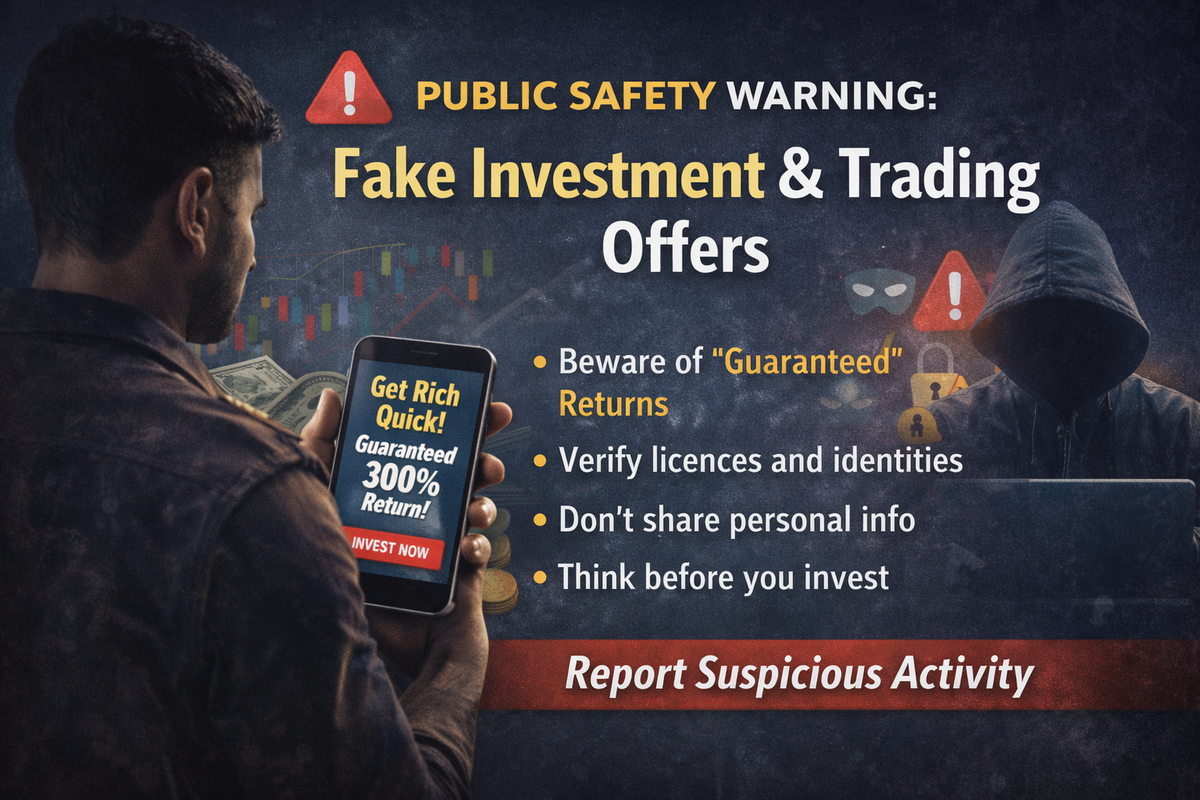
A message promising “guaranteed returns.” A trading app you have never heard of. A stranger on WhatsApp claiming they can multiply your money quickly. On the surface, it can look like an opportunity. In reality, it may be the start of a scam.
Fake investment and trading offers are designed to look convincing. They often borrow the language of finance, copy the style of real platforms, and create urgency so people act before they think. Regulators in the UAE have repeatedly warned investors to verify who they are dealing with before signing anything or sending funds. The Securities and Commodities Authority has specifically urged investors to verify the identity and licensing status of any entity before signing agreements or transferring money.
This matters because scams no longer arrive only through obvious spam emails. Official UAE guidance shows they now appear through cold calls, emails, WhatsApp, fake documents, social media, and websites that imitate legitimate institutions. The DFSA says cold calling is a common way scammers make first contact, and the CBUAE warns that fraudsters may misuse official names, logos, and addresses while offering fake loans, investment opportunities, or financial transactions.
Why fake investment scams work
These scams succeed because they are built on emotion, not logic. They usually target one or more of the following:
- greed: “Double your money fast”
- urgency: “Limited slot, invest today”
- authority: fake logos, fake approvals, fake compliance language
- trust: a friend referral, social proof, or screenshots of “profits”
- fear of missing out: “Everyone is already making money”
The scam is not always a simple request for money. Sometimes the real goal is to collect your ID, banking details, card information, OTPs, or remote access to your device. The CBUAE specifically warns that scammers may use fake documents and impersonation to trick people into sending money or personal data.
Common red flags to watch for
1) “Guaranteed” or unrealistic returns
If someone promises fixed profits with little or no risk, that is a major warning sign. Legitimate investing always involves risk. Dubai authorities have warned about schemes promising unrealistic monthly profits, while the DFSA’s own anti-scam guidance starts with a simple rule: if it sounds too good to be true, it probably is.
2) Pressure to act immediately
Scammers try to stop you from checking facts. They may say the offer ends in a few hours or that you must transfer now to “lock in” returns.
3) Unlicensed firms or unclear identities
If a company cannot clearly show who regulates it, where it is registered, and how you can independently verify that, do not send money. The SCA maintains public information on licensed companies, and it also publishes licensed telemarketers for trading promotions.
4) Requests to send money to personal accounts, unrelated overseas accounts, or crypto wallets
This is a serious red flag, especially when the payment destination does not match the supposed firm.
5) Fake documents, stamps, or logos
The DFSA has warned about scams that used the DFSA logo and the CBUAE logo and a fake CBUAE stamp to appear legitimate. A professional-looking form does not prove anything.
6) Cold calls, random WhatsApp messages, or social media contact
Unsolicited contact about financial products should be treated carefully. The DFSA says cold calling is commonly used by scammers, and cold calling about financial products by unlicensed firms claiming to be from the DIFC is illegal.
7) Strange email domains or fake support channels
The CBUAE warns that all its emails use the @cbuae.gov.ae domain, and it does not contact individuals through social media. That kind of detail matters when checking whether a message is genuine.
How to avoid fake investment and trading scams
The safest approach is to slow down and verify everything independently.
Do this before you trust any offer
Verify the licence.
Check whether the firm appears on the relevant official register. In the UAE context, that can include SCA records and, where relevant, DFSA records. Do not rely on a screenshot the sender gives you. Check the regulator’s public register yourself.
Verify the caller and the company separately.
Search the official website yourself, not through a link sent in a chat. Call the published number from the official site if needed.
Inspect the payment destination.
If the company name and the receiving account do not match, stop.
Treat “proof of profit” with caution.
Screenshots, chat testimonials, and dashboard balances can be edited or fabricated.
Pause when you feel rushed.
Urgency is often part of the scam.
Protect your device.
Do not install unknown apps or give remote access to your phone or computer just because someone claims it is needed for “verification” or “trading setup.”
Dos and don’ts
Do
- Do verify licences and identities through official registers before sending funds.
- Do read the email domain carefully, especially when a sender claims to represent a regulator or bank.
- Do keep records of chats, numbers, screenshots, receipts, and transaction details if something feels suspicious.
- Do report suspicious activity through official channels if you believe you were targeted. In the UAE, the MOI provides an online criminal reporting service, and Dubai Police provides an eCrime reporting platform for incidents within Dubai.
Don’t
- Don’t trust guaranteed profit claims.
- Don’t send money just because the message looks professional.
- Don’t rely on social media comments, influencer-style promotions, or pressure from strangers in group chats.
- Don’t share OTPs, card details, Emirates ID copies, or banking credentials with unverified parties.
- Don’t assume a polished website means a business is regulated. The DFSA explicitly warns that a simple internet search may not be enough because scammers can build sophisticated websites.
What to do if you already interacted with a scam
If you already replied, clicked a link, shared details, or transferred money, act quickly.
First, stop all further communication with the suspected scammer. Second, contact your bank or payment provider immediately. Third, preserve evidence: messages, account details, receipts, phone numbers, email headers, and screenshots. Fourth, report the incident through official channels. The MOI’s reporting service accepts reports online, and Dubai Police’s eCrime platform is available for cybercrime complaints in Dubai.
Why this is serious under UAE law
Under Federal Decree-Law No. 34 of 2021 on Countering Rumors and Cybercrimes, internet fraud can carry imprisonment and/or a fine ranging from AED 250,000 to AED 1,000,000. The same law also provides penalties for promoting a fictitious portfolio or company to receive funds from the public for investment without a licence, including imprisonment of up to five years and/or a fine between AED 250,000 and AED 1,000,000, with illegally seized funds to be refunded.
That legal backdrop is important for two reasons. First, it shows how seriously the UAE treats online financial deception. Second, it reminds the public not to spread unverified accusations online. Focus on reporting suspicious conduct through official channels and sharing prevention advice, not naming or shaming individuals without verified facts.
Conclusion
Fake investment and trading scams are not always obvious. Many now look polished, urgent, and believable. But the pattern is usually the same: fast profits, pressure, unclear licensing, and a push to send money before proper checks are done.
The safest habit is simple: slow down, verify independently, and never let urgency replace due diligence. A real opportunity can survive a few minutes of checking. A scam usually cannot.
Key takeaways
- Guaranteed or unusually high returns are a major red flag.
- Always verify a firm’s identity and licence before signing or transferring funds.
- Be cautious with cold calls, WhatsApp messages, fake apps, and social media promotions.
- Fake logos, fake stamps, and professional-looking forms do not prove legitimacy.
- If targeted, keep evidence and report through official channels such as MOI or Dubai Police eCrime.
Source owners:
Securities and Commodities Authority (SCA), Dubai Financial Services Authority (DFSA), Central Bank of the UAE (CBUAE), UAE Ministry of Interior (MOI), Federal Decree-Law No. 34 of 2021 on Countering Rumors and Cybercrimes. (هيئة سوق المال)
Disclaimer: This article is provided for educational and informational purposes only. It does not constitute legal, financial, cybersecurity, or professional advice. Readers should verify important information through official sources before taking action.